ADHD and the People You Love: How Individual Therapy Can Help You Show Up Differently
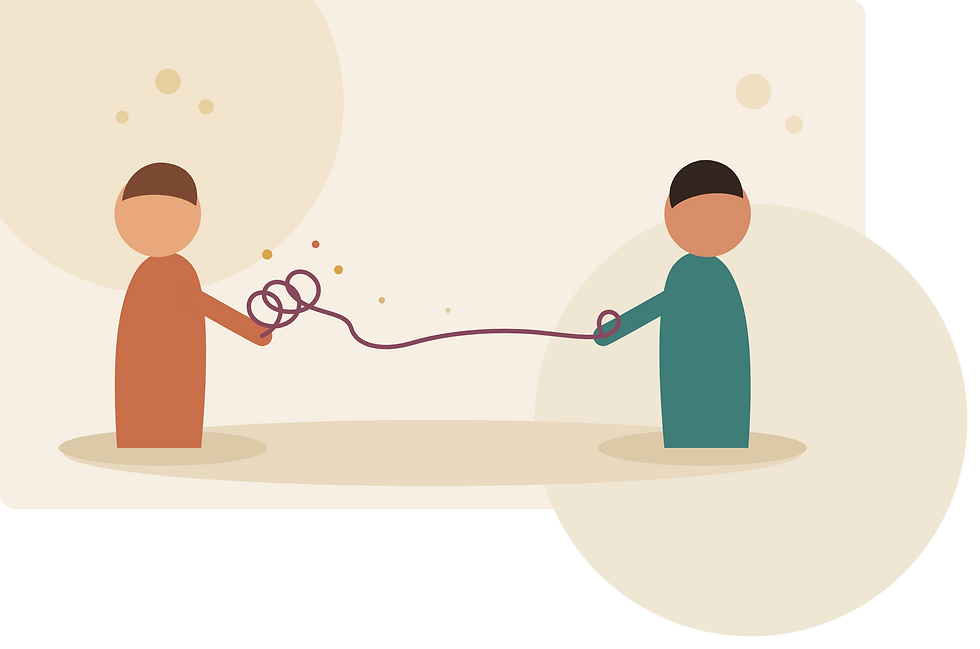
If you're an adult with ADHD, there's a decent chance you've heard some version of the same feedback across very different relationships. A partner who says you don't listen. A friend who stopped texting after you cancelled one too many times. A parent who still calls you scattered. Perhaps an ex who told you, on the way out, that being with you felt like raising a teenager.
That kind of feedback hurts — and if you have ADHD, it probably hurts more than people realise, because many of us with ADHD feel criticism with unusual intensity. The temptation is either to collapse into shame ("I'm just a bad partner") or to armour up ("they're too demanding"). Neither is accurate, and neither helps.
There's a third option: understanding precisely how your ADHD shows up in relationships, and working — often in individual therapy — to change the parts that are changeable. This post is about what that work looks like. It draws on the couples-focused writing of Melissa Orlov, Gina Pera, Ari Tuckman, and Ned Hallowell, but turns the lens around: not "how do we fix the relationship," but "what can I do, on my side of the net, that makes my relationships better?"
One thing to say up front: this is not about accepting the role of the broken one. Relationship difficulties in ADHD-affected couples are co-created — your partner's responses to your symptoms are their responsibility, not yours. But you can only work on your half, and it turns out your half is substantial.
First, understand what your partner is actually experiencing
A core insight from Melissa Orlov's work with couples is that most of the damage isn't done by ADHD symptoms directly, but by what those symptoms mean to the other person. She describes a chain: symptom → partner's response → your response to their response. You forget to book the restaurant; your partner reads it as "I don't matter to him"; they get cold or sharp; you feel ambushed and defend or withdraw; now you're fighting about the fight.
From inside the ADHD brain, the forgotten booking was a working-memory glitch — nothing to do with love. But your partner can't see your intentions; they can only see the pattern. And the pattern, over years, tells a story: this person's attention goes everywhere except to me and our shared life.
This is worth sitting with, uncomfortable as it is. Many ADHD adults are so used to defending their intentions ("I didn't mean to!") that they never fully take in the other person's experience. In individual therapy, this is often an early piece of work: learning to hold two truths at once — my intentions were good and the impact on them was real — without collapsing into shame or defensiveness. Impact is what your relationships are built from.
It also helps to know the predictable trajectory Orlov describes. ADHD hyperfocus often makes courtship spectacular: you were fascinated, attentive, spontaneous. When the novelty faded and your attention returned to baseline, your partner experienced a loss you may not even have noticed. If your partner seems to be grieving someone you don't remember being — that's who.
The trap to watch for: becoming the child in your own home
The most common destructive pattern in these relationships is what Orlov calls the parent–child dynamic. Your partner, tired of dropped balls, starts reminding, checking, and taking over. You experience this as nagging and control, so you avoid, tune out, or quietly rebel — which produces more dropped balls, which produces more supervision. Eventually one of you is an exhausted, resentful manager and the other is a monitored, demoralised subordinate. Desire, respect, and fun do not survive long in that arrangement.
Here's the part that matters for individual work: you cannot ask your partner to stop parenting you while the balls keep dropping. The only durable exit from this dynamic is for you to become genuinely, visibly reliable in the areas you own — not perfect, but reliable enough that supervision becomes unnecessary. That is a project you can pursue on your own, and it's one of the most loving things an ADHD partner can do.
What individual therapy for ADHD actually works on
Good individual therapy for an ADHD adult is not just talking about your childhood (though there may be real material there — decades of criticism leave marks). It's typically a blend of psychoeducation, skills-building, and emotional work. Here are the main threads.
1. Getting an accurate model of your own brain
Russell Barkley's formulation is useful: ADHD is not a disorder of knowing what to do, but of doing what you know. Your difficulties with initiating tasks, tracking time, holding intentions in mind, and regulating emotion are executive function differences — not moral failings, and not fixable by trying harder in the same way.
This matters relationally for two reasons. First, it dissolves shame enough that you can look at your behaviour honestly instead of flinching away from it. Second, it changes your strategy: if willpower were going to work, it would have worked by now. What works is scaffolding — externalising the executive functions your brain doesn't reliably supply.
Therapy is also where you take stock of the full treatment picture. Orlov describes effective ADHD management as a three-legged stool: physiological support (medication where appropriate, sleep, exercise), behavioural systems, and relationship work. A therapist can help you assess whether your first two legs are actually in place, because relationship change built on an untreated brain tends to collapse.
2. Building reliability systems — and treating them as acts of love
This is the unglamorous heart of the work: shared calendars you actually check, alarms for transitions, a single capture point for every commitment you make, written notes after important conversations, routines that don't depend on remembering. Gina Pera is blunt about this: sincerity is not a system. A heartfelt promise that lives only in ADHD working memory is, statistically, a future disappointment.
A reframe that many people find powerful in therapy: these systems are not humiliating crutches; they are how you keep your word. Every alarm you set is a small message to the people you love that their time and needs are safe with you. Reliability, for an ADHD adult, is not a personality trait — it's an engineering achievement. And it's available.
Therapy adds value here that a productivity book can't: a therapist helps you notice why your systems fail (the resentment that makes you ignore the alarm, the perfectionism that makes you abandon a system after one missed day, the shame that stops you from restarting), and helps you build habits of repair rather than cycles of all-or-nothing.
3. Learning to regulate the emotional flash-flood
Many ADHD adults experience emotions fast, hot, and hard to modulate, and are acutely sensitive to perceived rejection or criticism — sometimes described as rejection sensitive dysphoria. Relationally, this often looks like: your partner raises a small issue, your nervous system registers an attack, and within seconds you're defending, counter-attacking, or shutting down. Your partner learns that feedback is dangerous, stops raising things, and starts withdrawing instead. Nothing gets resolved; distance accumulates.
Individual therapy is an ideal place to work on this, because you can practise without the stakes of a live fight. Common threads include: learning to recognise your own flooding early (heat, speed, the urge to interrupt); building a pause — even a scripted one ("I want to hear this and I need ten minutes first"); and gradually rewriting the internal story so that your partner's complaint registers as information rather than verdict. Hallowell makes the point that the great enemy here is shame: an ADHD adult who has made peace with their brain can hear "you forgot again" as a logistics problem; one who hasn't hears it as "you are defective," and reacts accordingly.
4. Repairing well, and repairing fast
You will still drop balls. The difference between ADHD adults whose relationships thrive and those whose relationships erode is often not the error rate but the repair rate. A good repair has a recognisable shape: name what happened without being asked; acknowledge the impact on them, specifically; skip the extended self-flagellation (which forces your partner to comfort you for hurting them); and say what you're changing so it's less likely next time — then actually change it.
Therapy helps here because many ADHD adults have a lifetime habit of either over-apologising from shame or under-apologising from defensiveness. Learning to repair cleanly — accountable but not grovelling — is a skill, and it transfers to every relationship you have.
5. Attention as a deliberate practice
Distractibility during conversation is one of the most quietly wounding symptoms, because to the other person it looks exactly like indifference. And because ADHD attention is pulled by stimulation, long-term partners — familiar, comfortable, non-novel — are at a structural disadvantage against your phone.
The work here is deliberately choosing where your attention goes in the moments that matter: phones physically elsewhere during meals and conversations; brief but genuinely undivided daily check-ins rather than long half-present evenings; scheduling novel, engaging activities together, because (as Ari Tuckman's work on ADHD couples emphasises) fun and shared stimulation are not extras — they're the conditions under which the ADHD brain naturally attends to a partner. Planned spontaneity sounds like a contradiction; for ADHD, it's a strategy.
6. Processing your own grief and building self-respect
Finally, individual therapy is a place for your pain, which is real and often unwitnessed: years of underachievement relative to your abilities, relationships lost to patterns you didn't understand at the time, possibly a late diagnosis and the vertigo of re-reading your whole life through it. Working through this matters relationally too. Self-compassion is not a consolation prize — it's load-bearing. People who have stopped being at war with themselves are dramatically less defensive, more able to hear feedback, and more generous partners.
What to tell your partner about this work
If you're in a relationship now, it's worth being open about what you're doing — not as a promise ("I'll change, I swear") but as observable action: "I've started therapy focused on my ADHD, I'm setting up systems for the things I keep dropping, and I'd like you to tell me the two things that would make the biggest difference to you." That last question is powerful: it focuses your limited change-energy where it buys the most goodwill, and it signals that their experience is finally being taken seriously.
Two caveats. First, if your partner is willing, couples work and shared reading (Orlov's The ADHD Effect on Marriage is the standard recommendation) multiply the effect of your individual work — because their half of the dynamic needs attention too, and that's not something you can do for them. Second, be patient with their scepticism. If the pattern has run for years, they've heard promises before. Trust rebuilds on evidence, at the speed of evidence.
The bottom line
ADHD will always be part of how you love: your intensity, spontaneity, humour, and originality come from the same brain as your forgetfulness and time blindness. The goal of individual therapy isn't to sand you down into someone neurotypical. It's to make sure the people you love actually receive the love you feel — reliably, visibly, in the currency of attention and follow-through — instead of having to take it on faith. That translation work is learnable. It's some of the most worthwhile work an ADHD adult can do.
Further reading
Melissa Orlov, The ADHD Effect on Marriage
Gina Pera, Is It You, Me, or Adult A.D.D.?
Ari Tuckman, ADHD After Dark and More Attention, Less Deficit
Edward Hallowell & John Ratey, ADHD 2.0 and Delivered from Distraction
Russell Barkley, Taking Charge of Adult ADHD
(Framed by Barry Ryan, fleshed out by Claude)


Comments